
Yield and Texture
Without sacrificing eating quality.
WTI offers both clean label phosphate alternatives and conventional phosphate solutions to help you maintain yield, texture, and eating quality throughout processing. The result: consistent performance, formulation flexibility, and technical support from reformulation through scale-up.


Yield and texture are decided long before the final cook, but they show up in every bite.
Removing phosphates raises real questions. WTI helps you answer them.
Phosphates do more than one job at once: buffering pH, binding water, reducing purge, and stabilizing texture. That multifunctionality is exactly why phosphate replacement is harder than most reformulations, and why WTI offers both clean label and conventional paths rather than a single answer.
Peer-reviewed research confirms phosphate replacement is uniquely difficult: no single natural ingredient matches phosphate’s combined water-binding, buffering, and textural functions. Source: Foods, 2025
Three challenges manufacturers face, and what resolves them:
Naturally cured and traditionally processed lines often never adopted phosphates or an alternative. That’s a common starting point. WTI can help you evaluate whether adding a solution now fits your application.
See how manufacturers are approaching this conversion → Convert to Natural
WTI Yield and Texture Solutions
Two Paths to Better Yield and Texture.
Whether you’re converting to clean label or upgrading a conventional solution, WTI offers a validated option to reduce purge and support yield for your application. Every formulation is different, so our technical team evaluates each one individually before recommending a path.

Clean Label · TenderIn® Overview
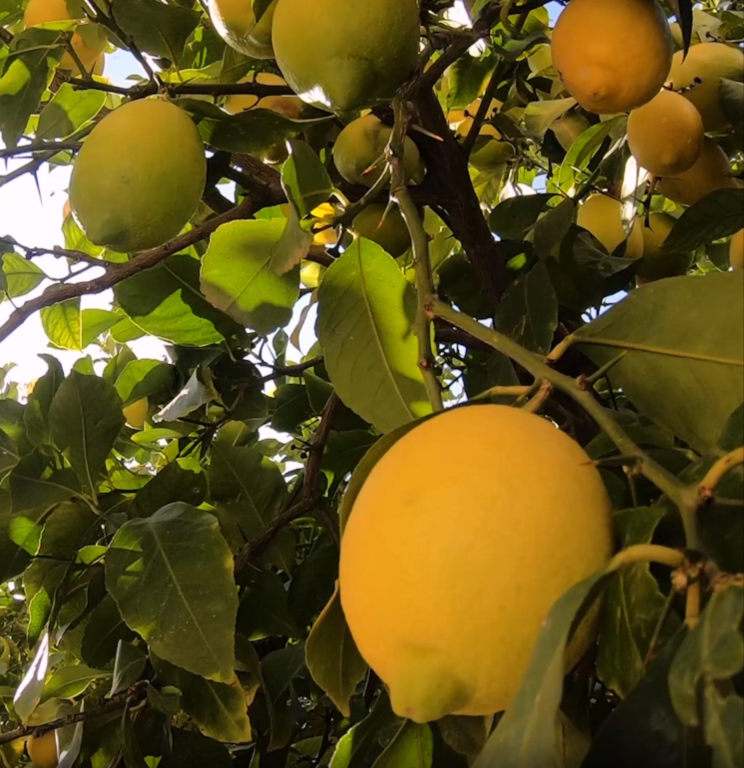
A Lemon-Based Alternative to Phosphates
Learn more about TenderIn®, WTI’s naturally-derived, lemon-based phosphate alternative for meat and poultry, then explore the product options below.

TenderIn® L · LK/LKX — Liquid
TenderIn® DL · 281 — Dry
ReplacesSodium & potassium phosphates
ApplicationsBeef · pork · poultry · prepared foods
LabelingLemon juice concentrate (with vinegar or rice flour in select SKUs)
Explore TenderIn® →
FunctionBuffered citrate that reduces purge and enhances moisture retention. Ional® is the only buffered sodium citrate approved by USDA as “safe and suitable” for meat and poultry, patented and exclusively manufactured by WTI.
ApplicationsFresh and RTE meat & poultry · deli
Explore Ional® →
FunctionWater-holding capacity & cook yield, at reduced sodium vs. sodium phosphate. It’s also highly soluble, dispersing immediately in cold water without requiring enzymatic breakdown.
ApplicationsFresh and RTE meat & poultry · deli
Explore Myosol® →Not sure which solution fits your application?
The WTI Process
What Working With WTI Actually Looks Like
Reformulation feels risky when you have a working formula. We make it structured, validated, and faster than you’d expect.
Step 1
Tell Us Your Challenge
Share your product category, current preservation or yield system, and what matters most, whether that’s yield, texture, sodium reduction, or clean label goals.
Step 2
Pathway Identification
WTI recommends solutions aligned with your formulation, processing, and performance requirements.
Step 3
Technical Guidance
Food scientists, application expertise, and technical data help reduce uncertainty during reformulation.
Step 4
Trial & Optimization
Pilot testing and formulation support accelerate commercialization. Yield validation and sensory evaluation confirm performance before commercial launch.
WTI’s vertically integrated operation in Jefferson, Georgia spans ingredient development through application support and validation testing, including ACRL, its ISO/IEC 17025:2017 accredited food safety laboratory.
See Capabilities for full facility and quality credentials.
Real Results
Explore Our Data
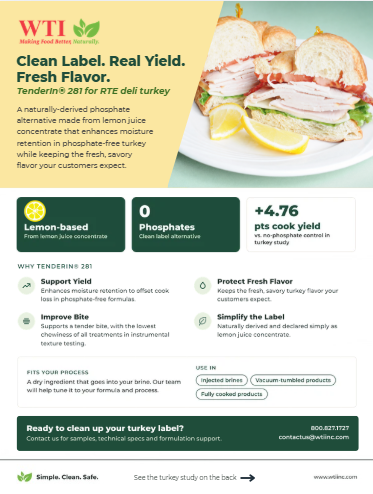
RTE Turkey Breast (TenderIn® 281 vs. phosphate and a phosphate-free control) — raised cook yield 4.76 points over the phosphate-free control, and earned the highest overall acceptability of all three treatments.
WTI application study, March 2026.
Frequently Asked Questions
Do I have to choose between clean label and conventional?
Why is phosphate replacement harder than other reformulations?
How can I reduce purge and improve moisture retention?
What if I’ve never used a phosphate or yield enhancer before?
Are TenderIn®, Myosol®, and Ional® interchangeable?
Can I reduce sodium while maintaining yield?
Ready to Improve Yield Without Sacrificing Eating Quality?
Let our team of food scientists help you identify the right solution for your application.